
Semantic Intelligence and Ontology
A shared model of business meaning, so every system, report, and AI model reads your data the same way.
Teaching machines your business logic.
Large language models are capable, but they do not natively understand your company's terminology, rules, or historical taxonomy. When two systems define 'customer' or 'revenue' differently, AI amplifies the confusion.
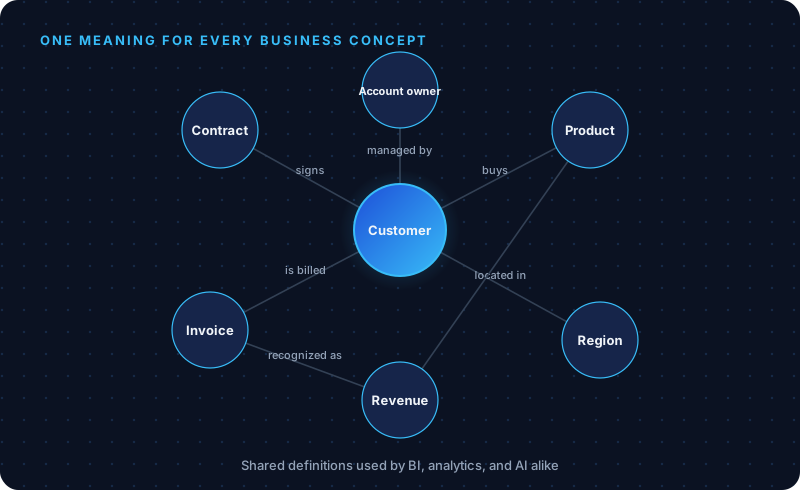
Semantic layers and ontologies translate raw enterprise data into structured, contextually aware knowledge, so retrieval, analytics, and agents produce consistent and explainable answers.
Representative deliverables
Enterprise ontology
A clear, maintainable map of business concepts, relationships, and terminology across departments.
Semantic layer design
Governed metric and entity definitions shared by BI tools, analytics, and AI applications.
Knowledge graph construction
Connected entities and documents that can be queried and reasoned over.
Context-aware retrieval
Search and extraction pipelines that understand that 'balance' in accounting is not 'balance' in HR.
How the work runs
Identify the concepts, relationships, terminology conflicts, and source systems that matter to the target workflow.
Create a practical semantic model that supports retrieval, integration, analytics, or policy enforcement.
Assign ownership for definitions and update the model as products, policies, and business language evolve.
Systems use consistent business meaning, retrieval is easier to explain, and teams have a maintainable model for shared knowledge.
Designed to work together
Custom LLM and RAG Applications
Production-grade generative AI grounded in your knowledge, permissions, and workflows.
Learn moreAnalytics and Decision Intelligence
Forecasting, prediction, and decision support tied to the decisions that matter.
Learn moreEnterprise Data Management
Integration, data quality, master data, and lineage that analytics and AI can rely on.
Learn moreStart with a structured assessment, not a speculative AI project.
In two to four weeks, we map your data, controls, and workflows, rank AI opportunities by value and risk, and hand you a roadmap your leadership can act on.